
 020 8163 2959
 Book A Free Consultation
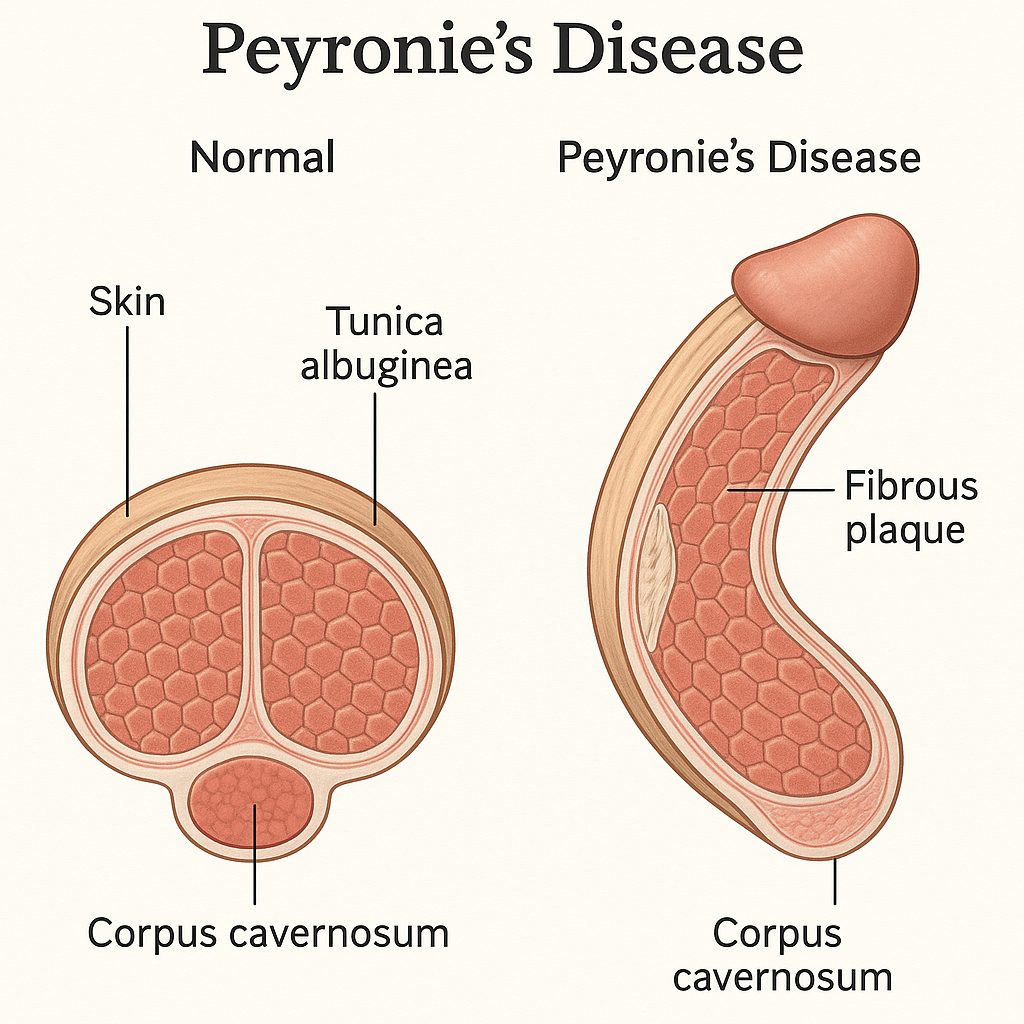
Peyronie's disease can cause a noticeable reduction in penile length due to the formation of fibrous scar tissue that restricts normal tissue expansion during erection.
Understanding How Scar Tissue Formation Affects Penile Length
Peyronie's disease develops when fibrous scar tissue, known as plaque, forms within the tunica albuginea—the thick sheath of tissue surrounding the erectile chambers of the penis. This condition typically occurs following injury or trauma to the penis, though in many cases the exact cause remains unclear. The scar tissue that develops is fundamentally different from the healthy, elastic tissue it replaces. While normal penile tissue can stretch and expand during erection to accommodate increased blood flow, scar tissue is rigid and inelastic.
When an erection occurs, blood fills the erectile chambers, causing them to expand. However, the areas affected by scar tissue cannot stretch in the same way. This inelasticity directly restricts the expansion of the penis during erection, resulting in a measurable reduction in length. The more extensive the scarring, the more pronounced the shortening effect tends to be. This physiological change is not merely cosmetic—it represents a genuine alteration in the functional capacity of the penile tissue.
The progression of scar tissue formation can vary considerably between patients. In some cases, the condition stabilises naturally after the initial acute phase, while in others, the plaque continues to develop over time. Understanding this mechanism is essential for patients experiencing penile shortening, as it highlights why early intervention and appropriate treatment can be crucial in managing the condition and potentially minimising length loss.
The Relationship Between Plaque Development and Penis Shortening
The fibrous plaques that characterise Peyronie's disease typically form on the dorsal (top) or lateral (side) aspects of the penis, though they can develop anywhere within the tunica albuginea. These plaques begin as areas of inflammation that gradually transform into dense, fibrous tissue. As the plaque matures and becomes more calcified, it creates a physical barrier that prevents the affected section of the penis from expanding fully during erection.
The location and size of the plaque directly influence the extent of penile shortening. Larger plaques or multiple areas of scarring compound the restriction on tissue expansion, leading to more significant length reduction. Additionally, plaques that develop circumferentially around the penis tend to cause more uniform shortening, while those on one side may contribute to both curvature and perceived length loss. The severity of shortening is not always proportional to the size of the plaque visible on ultrasound examination, as the functional impact depends on the plaque's depth and its interference with the erectile mechanism.
Research indicates that approximately 40-50% of men with Peyronie's disease experience some degree of penile shortening. This statistic underscores the commonality of this symptom and the importance of seeking specialist assessment. At Moorgate Andrology, our experienced urologists utilise advanced diagnostic imaging to accurately assess plaque formation and provide patients with a comprehensive understanding of how their specific condition may be affecting penile length.
How Penile Curvature Contributes to Perceived and Actual Length Loss
One of the hallmark features of Peyronie's disease is penile curvature during erection, which occurs because scar tissue prevents normal expansion on one side of the penis whilst the opposite side expands normally. This asymmetric expansion creates a bend towards the affected area. The resulting curvature contributes to both perceived and actual length loss in several ways.
From a geometric perspective, when the penis curves, the effective straight-line length from base to tip is reduced compared to a straight penis of the same tissue length. This represents a genuine reduction in functional length during sexual activity. The more severe the curvature, the more pronounced this effect becomes. A penis with a 60-degree curve, for instance, will have a noticeably shorter functional length than the same penis when straight, even if the tissue itself has not shortened.
Beyond the geometric considerations, severe curvature can make accurate measurement difficult and may create a perception of greater length loss than has actually occurred. However, it is important to recognise that in many cases, tissue shortening and curvature occur simultaneously. The scar tissue both pulls the penis into a curved shape and restricts overall expansion, creating a combined effect that can be particularly distressing for patients. Addressing the curvature through appropriate treatment may help restore some functional length, even when actual tissue shortening has occurred.
Patients often report that the psychological impact of perceived length loss can be as significant as the physical changes themselves. Understanding the distinction between actual tissue shortening and length loss due to curvature can help patients make informed decisions about treatment options and set realistic expectations for outcomes.
Medical Factors That Influence the Extent of Penile Shortening
Several medical and biological factors influence how much penile shortening a patient with Peyronie's disease may experience. The stage of the disease plays a crucial role—during the acute inflammatory phase, which typically lasts 12-18 months, the condition is still evolving and the extent of shortening may not yet be fully apparent. Once the disease enters the chronic stable phase, the plaque becomes more fixed and the degree of shortening stabilises.
Individual healing responses vary considerably and affect the development of scar tissue. Some patients have a genetic predisposition to excessive scarring or fibrosis, which may result in more extensive plaque formation and consequently greater length loss. Concurrent conditions such as diabetes, cardiovascular disease, or smoking can impair tissue health and healing, potentially exacerbating the effects of Peyronie's disease on penile length.
The initial cause of the condition also matters. Peyronie's disease resulting from significant trauma may produce different patterns of scarring compared to cases that develop gradually without an obvious precipitating event. Additionally, previous penile surgery or interventions may influence how scar tissue forms and the extent to which it affects length.
Treatment history is another important consideration. Patients who receive early, appropriate intervention during the acute phase may experience less progression of the disease and therefore less shortening. Conversely, delayed treatment or unsuccessful initial therapies may allow the condition to advance, resulting in more significant length loss. At Moorgate Andrology, our specialists conduct thorough assessments to identify the specific factors affecting each patient, enabling personalised treatment strategies designed to address their unique circumstances.
Treatment Options to Address Length Loss from Peyronie's Disease
Addressing penile shortening associated with Peyronie's disease requires a comprehensive approach tailored to the individual patient's condition, symptoms, and treatment goals. Treatment strategies vary depending on the stage of the disease, the severity of shortening and curvature, and the impact on sexual function and quality of life.
During the acute inflammatory phase, conservative medical management may help stabilise the condition and potentially reduce progression. Oral medications, including vitamin E, potassium aminobenzoate, and colchicine, have been used, though evidence for their effectiveness in preventing length loss is limited. Intralesional injection therapies, such as collagenase clostridium histolyticum, can help break down the fibrous plaque in selected cases, potentially improving curvature and functional length.
For patients in the chronic stable phase with significant curvature and length loss affecting sexual function, surgical intervention may offer the most effective solution. Several surgical techniques are available, each with specific indications and outcomes. Plication procedures involve placing sutures to straighten the penis by shortening the longer side, which does not restore lost length but can improve function. Plaque incision or excision with grafting aims to release the scarring and restore some elasticity, potentially improving both curvature and length. Penile prosthesis implantation is considered for patients with concurrent erectile dysfunction and can help restore rigidity and functional length.
At Moorgate Andrology, our GMC-registered urologists have extensive experience in treating Peyronie's disease and its associated complications. We offer comprehensive consultations to assess the nature and extent of penile shortening, discuss realistic treatment outcomes, and develop personalised treatment plans. Our surgical techniques are designed to minimise scarring, preserve erectile function where possible, and provide natural-looking results.
Recovery from Peyronie's disease treatment varies depending on the approach selected. Surgical procedures typically require several weeks of healing, with gradual resumption of sexual activity as advised by your surgeon. We provide comprehensive aftercare support to ensure optimal recovery and address any concerns that arise during the healing process. For patients concerned about the cost of treatment, we offer affordable financing options including 0% finance plans, making specialist care accessible to those who need it.
It is important for patients to maintain realistic expectations regarding length restoration. While treatment can often improve curvature, restore function, and in some cases recover some lost length, complete restoration to pre-disease dimensions may not always be achievable. However, many patients report significant improvements in sexual confidence and function following appropriate treatment. If you are experiencing penile shortening or other symptoms of Peyronie's disease, we encourage you to seek specialist assessment to explore the treatment options available to you.
About Moorgate Andrology
Moorgate Andrology is a UK-based specialist clinic providing penis enlargement surgery,penile fillers and peyronies disease management.
Treatments are delivered using a medically-led approach focused on safety, precision, and natural-looking results




LEAVE A REPLY Cancel Reply
Your email address will not be published. Required fields are marked *