Penis Enlargement Surgery UK – Complete Guide
Penis enlargement surgery involves specialist surgical procedures intended to increase visible penile length, girth or both in appropriately selected patients.
At Moorgate Andrology, treatment is provided by Consultant Urologists who assess each patient's anatomy, medical history and individual objectives before discussing the available surgical options.
This comprehensive guide brings together the key information patients need when researching penis enlargement surgery in the UK, including:
- The different surgical procedures and how they work.
- Length enhancement, girth enhancement and combined surgery.
- Who may be suitable for treatment.
- Potential results and realistic expectations.
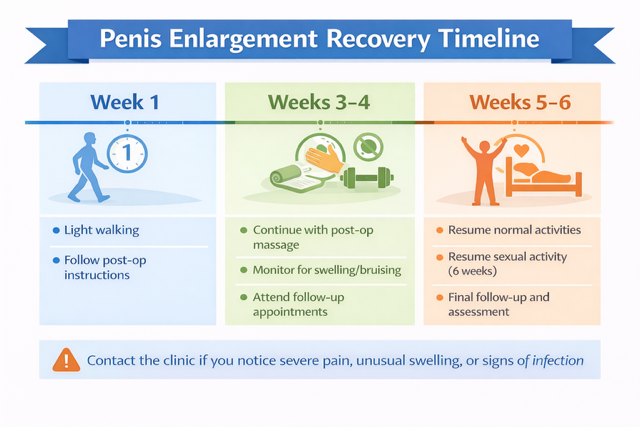
- Recovery, postoperative care and follow-up.
- Potential risks, complications and limitations.
- How surgical enlargement compares with penile filler treatment.
Our aim is to help patients understand the available options, ask informed questions and make decisions based on individual clinical advice rather than assumptions about what surgery can achieve.
Penis Enlargement Surgery: Length and Girth Enhancement
How Does Penis Lengthening Surgery Work?
Penis lengthening surgery at Moorgate Andrology involves releasing the suspensory ligament, a structure that attaches the penis to the pubic bone and helps support it.
Through an incision at the base of the penis, the Consultant Urologist accesses and releases the ligament. This allows more of the existing penile shaft to become visible externally, with the aim of improving visible penile length, particularly when the penis is flaccid.
An important consideration during the procedure is the potential for tissues to reattach during healing. At Moorgate Andrology, our urologists use a tissue interposition technique involving the patient's own surrounding tissues. This is intended to maintain separation between the released structures and reduce the possibility of reattachment and retraction.
This approach does not require a synthetic implant to maintain the space. The surgical technique is planned according to the patient's anatomy and discussed during the consultation.
The procedure does not involve cutting into the erectile bodies themselves. However, it remains a specialist operation with potential risks and complications. Individual outcomes vary, and the aim is to improve visible length while preserving penile function.
How Does Penis Girth Enhancement Surgery Work?
Penis girth enhancement surgery at Moorgate Andrology uses fat transfer to increase penile circumference. It may be performed alongside lengthening surgery or as a standalone procedure, depending on the patient's anatomy, clinical suitability and treatment objectives.
The procedure involves harvesting fat from an area of the patient's body, commonly the abdomen or inner thighs. The harvested fat is then processed to remove unwanted fluid and other material, preparing it for transfer.
The purified fat is carefully transferred into the penis using an appropriate injection technique. The amount used is determined by the patient's anatomy, treatment objectives and the Consultant Urologist's clinical judgement.
Not all transferred fat survives. Some of the fat is naturally absorbed by the body during the healing process. The proportion retained varies between patients and depends on factors including tissue characteristics, healing and the establishment of an adequate blood supply to the transferred fat.
The final increase in penile circumference therefore varies, and a particular amount of additional girth cannot be guaranteed.
One consideration of using the patient's own fat is that it avoids introducing a hyaluronic acid filler or other synthetic filler material. Successfully retained fat can provide a longer-term increase in girth, unlike temporary hyaluronic acid penile fillers, although the final result may change over time.
How Much Bigger Will My Penis Be After Surgery?
The results of penis enlargement surgery vary between patients and depend on the procedure performed, individual anatomy, surgical technique and the body's healing response.
Penile Lengthening
Penis lengthening surgery aims to increase visible penile length, particularly when flaccid. By releasing the suspensory ligament, more of the existing penile shaft can become visible externally.
The procedure does not directly increase the anatomical length of the erect penis. Following recovery, a penile stretching device may be recommended by your Consultant Urologist as part of the postoperative programme.
Where prescribed, the device is intended to support the postoperative result. Its use may begin around six weeks after surgery, depending on the surgeon's instructions and individual recovery. Any effect on erect length will vary and cannot be guaranteed.
Penile Girth Enhancement
Fat transfer surgery aims to increase penile circumference in both the flaccid and erect states.
The final result depends partly on how much of the transferred fat survives and establishes a blood supply. Some absorption is expected during the healing process, meaning the initial postoperative appearance may differ from the longer-term result.
The amount of additional girth retained varies between individuals, and a specific increase cannot be guaranteed.
Combined Length and Girth Enhancement
Some patients may be suitable for a combination of lengthening and girth enhancement procedures.
Combining these procedures can address visible length and penile circumference within the same treatment plan. However, suitability, recovery requirements and expected outcomes need to be assessed individually.
What Factors Influence the Results?
The outcome of penis enlargement surgery can be influenced by:
- Initial penile anatomy and dimensions.
- The surgical technique used.
- The amount of transferred fat retained following treatment.
- Individual healing and tissue response.
- Following postoperative instructions.
- Attending recommended follow-up appointments.
The aim of penis enlargement surgery is to improve visible length, increase girth where appropriate and achieve proportions that are suitable for the individual patient.
No specific increase in length or circumference can be guaranteed. A detailed consultation with a Consultant Urologist is essential to understand what may realistically be achievable in your circumstances.
What Can Penis Enlargement Surgery Not Do?
Penis enlargement surgery can improve certain penile dimensions, but it is important to understand what the procedures cannot achieve before considering treatment.
It Cannot Guarantee a Dramatic Increase in Erect Length
Penile lengthening surgery involves releasing the suspensory ligament to improve visible penile length, particularly when flaccid. It does not directly lengthen the erectile bodies or guarantee an increase in erect penile length.
It Cannot Guarantee a Particular Result
Every patient has different anatomy and healing characteristics. Although surgery may produce improvements in visible length or girth, the final outcome varies between individuals. No specific increase in length or circumference can be promised.
It Does Not Treat Erectile Dysfunction
Penis enlargement surgery is designed to address penile dimensions, not erectile function. If you experience erectile dysfunction, this should be assessed separately. Your Consultant Urologist can discuss appropriate treatment options where necessary.
It Cannot Replace Realistic Expectations
The aim is to achieve an improvement that is appropriate for your anatomy and treatment goals, rather than an unrealistic or excessive change.
A responsible surgical approach involves understanding what may be achievable, as well as the limitations, potential risks and recovery requirements. An individual consultation with a Consultant Urologist is essential before deciding whether surgery is right for you.
For further information, read our guide to what penis enlargement surgery can and cannot do.
The Tissue Interposition Technique: An Advancement in Penis Lengthening Surgery
At Moorgate Andrology, Consultant Urologists Dr Nenad Djakovic and Dr Gerasimos Fragkoulis use a tissue interposition technique as part of their approach to penis lengthening surgery.
Following release of the suspensory ligament, the body begins its natural healing process. During this period, scar tissue can form and the released tissues may reattach. This can contribute to some loss of the initial improvement in visible length.
The tissue interposition technique uses the patient's own surrounding tissues to help maintain separation between the released structures during healing. The aim is to reduce the likelihood of reattachment and subsequent retraction, without relying on a synthetic implant as a spacer.
Potential advantages of this approach include:
- Helping to maintain separation between released tissues during healing.
- Aiming to reduce the risk of tissue reattachment and retraction.
- Supporting the preservation of improved visible flaccid length.
- Avoiding the use of a synthetic implant as a tissue spacer.
As with any surgical technique, outcomes depend on individual anatomy, surgical planning and the healing process. The technique cannot eliminate all complications or guarantee that a particular length improvement will be maintained.
Tissue Interposition Compared with Silicone Implant Techniques
Different surgeons use different approaches to maintaining separation following suspensory ligament release. Some techniques involve placing a silicone implant or other material between the released structures, whereas tissue interposition uses the patient's own surrounding tissues.
Understanding the differences can help patients ask informed questions when comparing surgical approaches.
Read our detailed guide: How the Tissue Interposition Technique Compares with Traditional Silicone Implant Techniques in Penis Lengthening Surgery
Am I Suitable for Penis Enlargement Surgery?
Not every man is suitable for penis enlargement surgery. Suitability depends on individual anatomy, general health, medical history, psychological readiness and expectations.
At Moorgate Andrology, every patient considering surgery undergoes an individual assessment with a Consultant Urologist before any treatment recommendation is made.
The assessment may consider:
- Penile anatomy: Including existing dimensions, proportions and the position of the suspensory ligament where relevant.
- Skin and tissue characteristics: Including factors that may affect the suitability of lengthening or fat transfer procedures.
- General health and medical history: Including previous penile procedures, relevant medical conditions and factors that could affect surgery or recovery.
- Treatment objectives: Understanding the patient's reasons for seeking treatment and what they hope to achieve.
- Psychological readiness: Considering whether the patient understands the limitations of surgery and has realistic expectations.
Psychological Readiness and Realistic Expectations
Physical suitability is only one part of the assessment. Patients should understand what surgery may achieve, its limitations, potential complications and the recovery involved.
Where appropriate, the Consultant Urologist may recommend further assessment or input from other healthcare professionals, including psychological support.
Who May Not Be Suitable?
Some men may be advised against surgery because of their anatomy, medical circumstances, expectations or other factors that could affect their safety or likely outcome.
Depending on the findings, the urologist may recommend further investigation, an alternative treatment or no treatment.
Only an individual clinical assessment can determine whether penis enlargement surgery is an appropriate option.
For more information, read our guide to who is suitable for penis enlargement surgery.
You may also find our guide to the risks and complications of penis enlargement surgery helpful when considering whether treatment is right for you.

 020 8163 2959
 Book A Free Consultation
 Ask a question